7 Stair Lift Alternatives to Consider For Your Home
Posted on by Eric Rubel
As a leading provider of accessibility solutions, Lifeway Mobility understands that every individual’s mobility needs are unique. While a stair lift is often an excellent solution for improving home access for individuals with limited mobility that are having trouble with the stairs, it may not be the best or most preferred solution for everyone.
For some, a stair lift might be impractical or less suitable for their accessibility or mobility needs or based on the width of the staircase. If an individual is unable to safely transfer onto a chair on their own (or from their wheelchair), a stair lift is not typically a recommended solution.
For others, they may not like the idea of adding a chair onto their staircase or prefer a solution that is more aesthetically pleasing or provides more convenient access to multiple floor levels.
Fortunately, there are several alternative solutions to consider:
Stair Lift Alternatives
Use the links to jump to the stairlift alternative you're interested in, or simply scroll down to start reading the rest of the post.In this post, we review these common stair lift alternatives to help you make the best decision for your mobility needs, home, and lifestyle.
Home Lifts (aka Through-Floor Elevators)
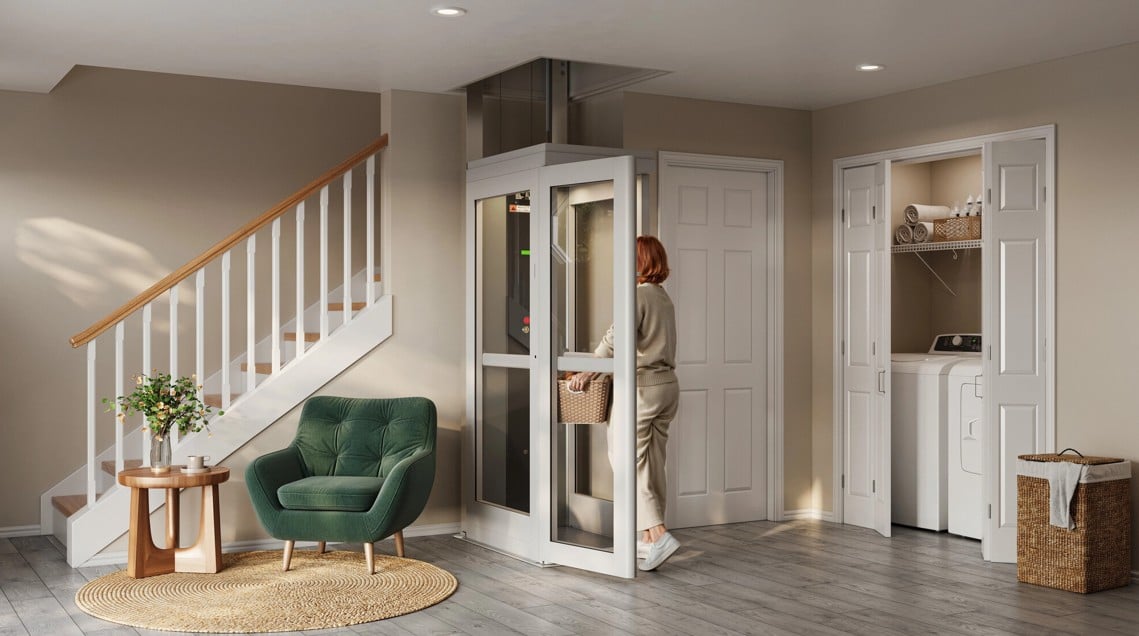
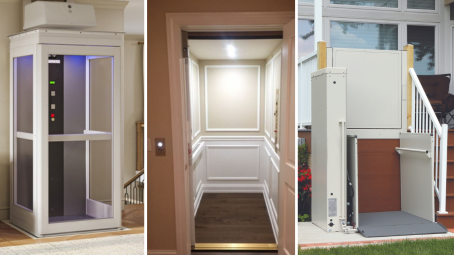
Home lifts, also known as “through-floor elevators” or “shaftless elevators”, are a very common alternative to a stair lift as they also offer an easier and more convenient way to navigate between two-floor levels of a home. While more costly than a stair lift, home lifts are more suitable for wheelchair and powerchair users and can carry more than one person at a time, depending on the size of the cab selected.
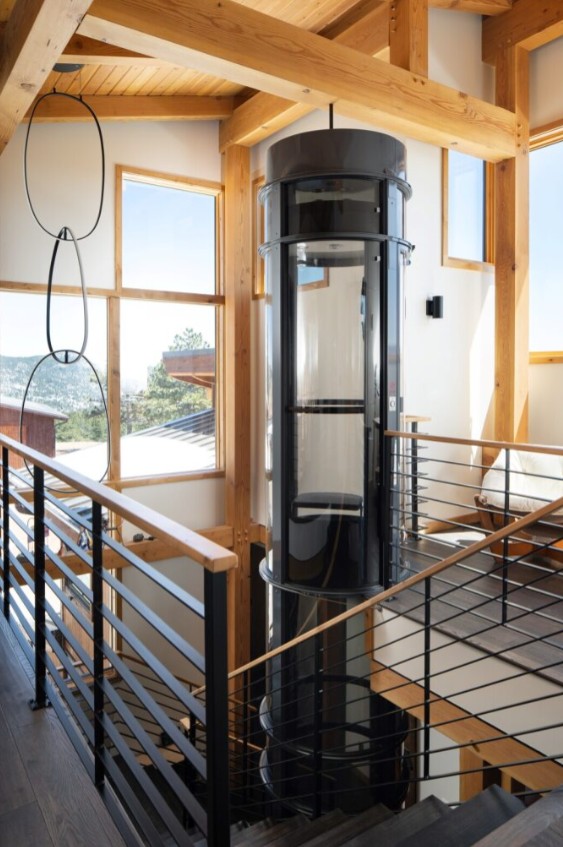
Unlike a traditional home elevator, through-floor home lifts do not require a hoist way, which means less construction and more usable space when compared to a traditional elevator.
Pros
- No transfers required, making it more suitable for wheelchair/powerchair users
- Can carry more than 1 person
- Flexibility regarding location of installation within home
Cons
- More costly than a stair lift, typically ranging between $35k-$55k
- Travel is limited to two floor levels
- Longer turn-around and installation time when compared to a stair lift
Home Elevators (Traditional)
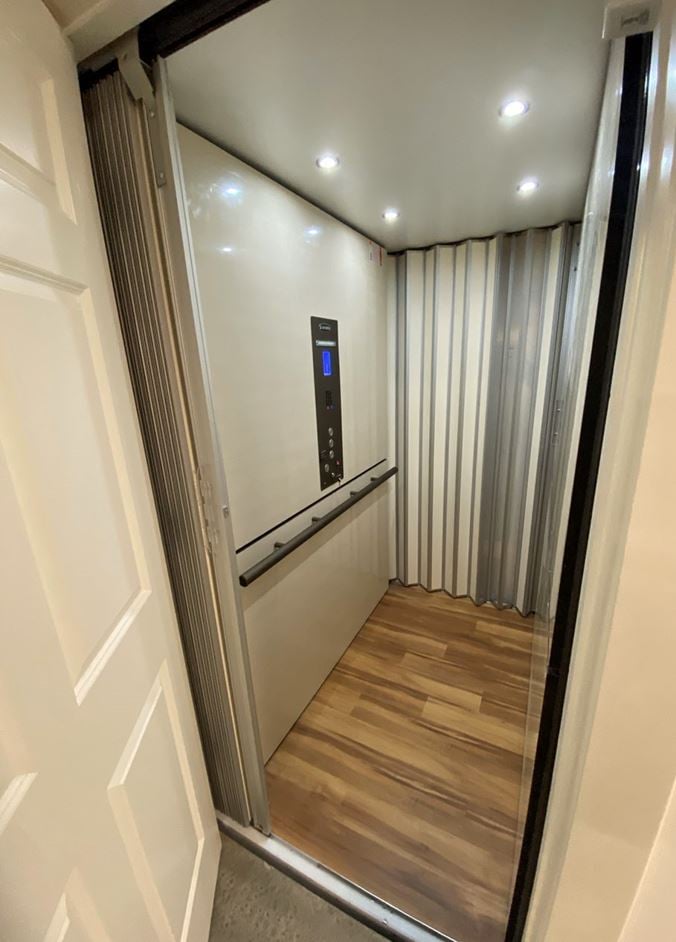
Traditional style home elevators built in a hoistway offer a long-term solution for individuals looking for safe and easy access to multiple-floor levels of their current home or a new home being constructed. While more expensive and time-consuming to install than a stair lift, home elevators can be customized to your home design and décor and offer one of the most convenient ways to travel between floor levels.
Pros
- Safe & convenient multi-floor access with the push of button
- Customize design options to seamlessly fit into your home
- Adds long-term value to your home
Cons
- More costly than a stair lift, with prices starting at $50k for home elevators
- Additional costs for construction and/or home modifications needed
- Longer project timeline
Platform Lifts
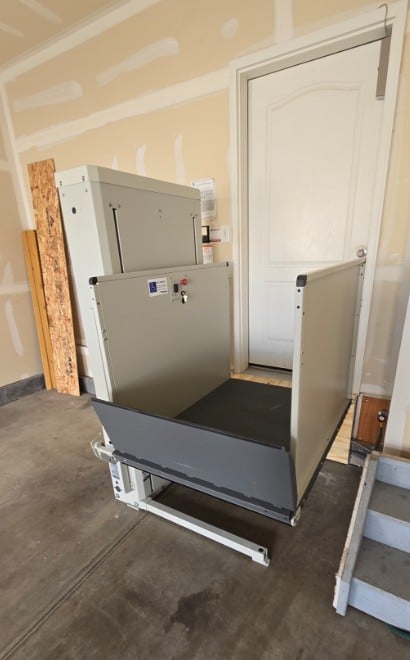
Another alternative that is also ideal for wheelchair and powerchair users is a platform lift. While typically found outdoors and more ideal for making a main entryway accessible, platform lifts can be built inside homes for individuals to safely navigate between two floor levels or up to 14’.
Like traditional elevators, construction may be required to build a hoistway to contain the lift, which can lead to a longer and more expensive installation when compared to stair lifts. However, when compared to home elevators, wheelchair platform lifts are more affordable and can be installed quicker in most cases.
Pros
- Wheelchair friendly – no transfers to/from seat to wheelchair required
- Low cost-alternative to elevator if applicable
- Can fit in tight spaces
Cons
- More expensive than a stair lift
- Limited travel distance
- Typically requires construction for indoor applications
Home Modifications
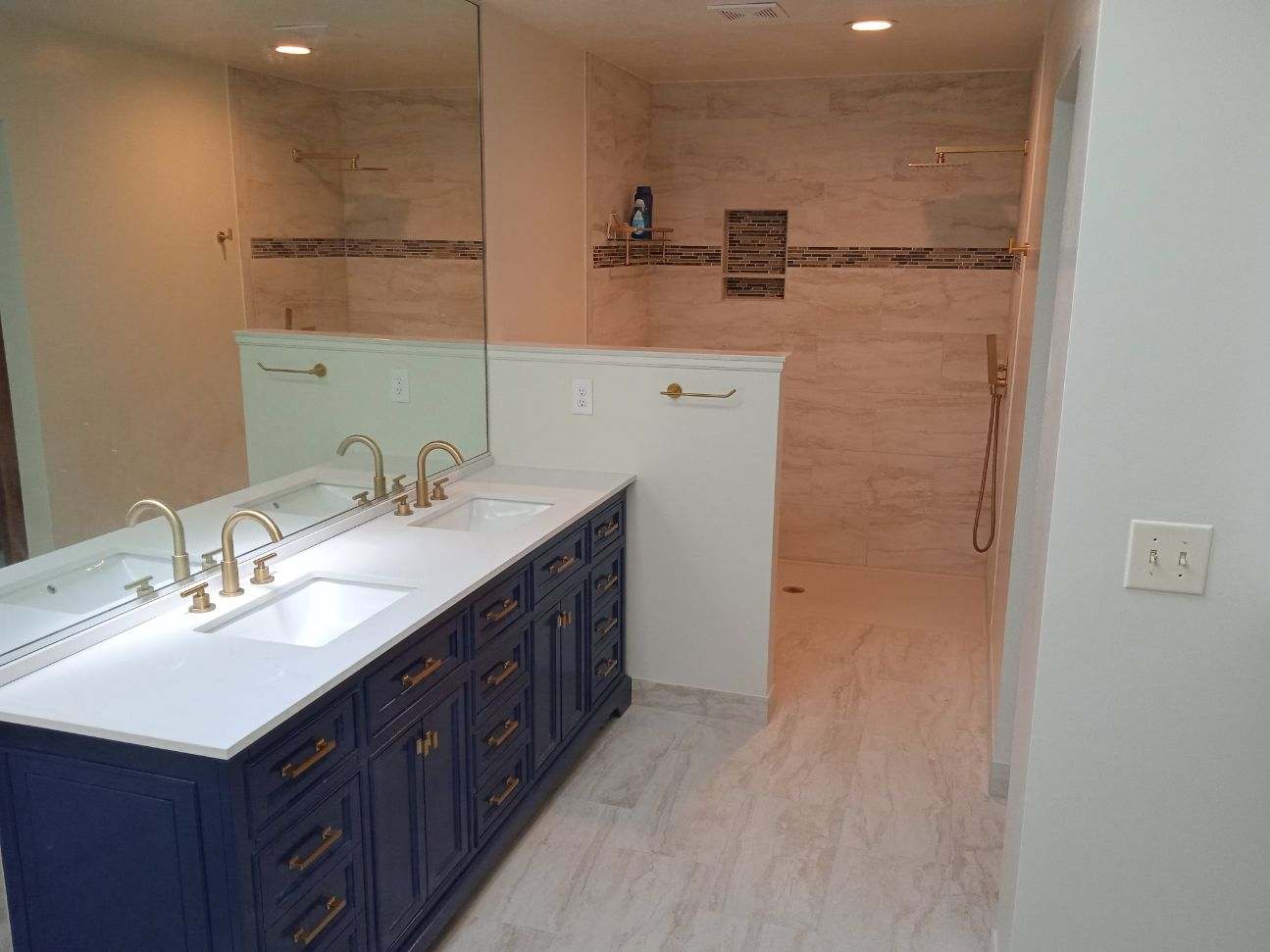
Some of the stair lift alternatives mentioned above can often be described as “home modifications”, especially if construction is required. However, in this section, we’re talking about more significant structural or layout changes to a home.
If space is allowed, you may have the option to modify the first level of your home to add a bedroom and/or a full bathroom. While this option would help increase safety and help prevent a fall on the stairs, it will still limit access to the second-floor level of your home and is likely to be a costly alternative.
Pros
- Removes worry of having to use the stairs
- Allows you to stay in your current home
Cons
- Safe access to 2nd floor level(s) of home is still limited
- Reduces “usable” space in main level of your home
- Typically, longer timeline and installation for construction/renovations
Stair Climbers
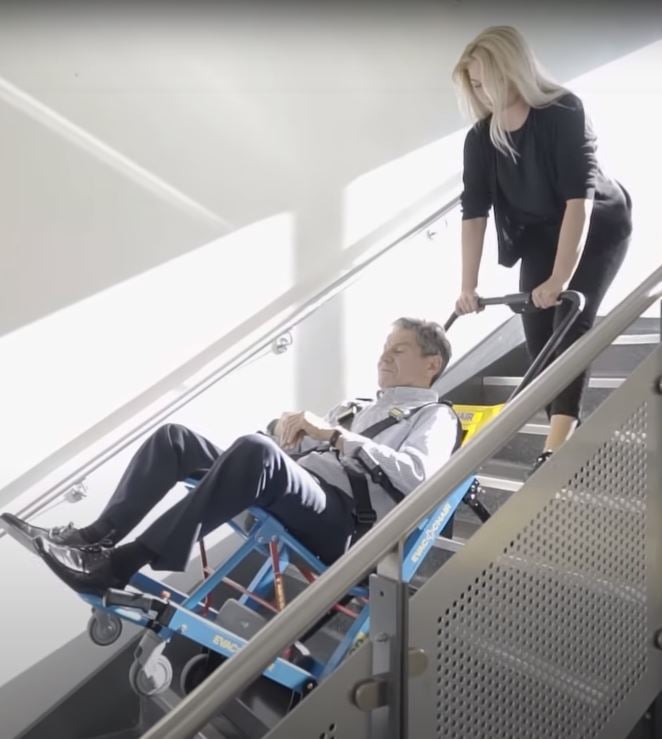
Attaching to most standard wheelchairs, stair climbers provide an easy way to move a person in a wheelchair up and down stairways with the touch of a button. While this requires assistance from an able-bodied person, it is ideal for short-term needs and offers another alternative solution to consider. Stair climbers can also be easily loaded into vehicles for use in other buildings or houses that have stairs.
Pros
- Does not require installation, or modification to your current home
- Portable and easy to store & transport for use on staircases at home & elsewhere
- Typically, more affordable than a stair lift
Cons
- May not be safe to use on steep, narrow, or curved staircases
- Even though they’re portable, these devices can be heavy to transport & use
- Requires assistance from an able-bodied person, which limits independence
Wheelchair Ramp
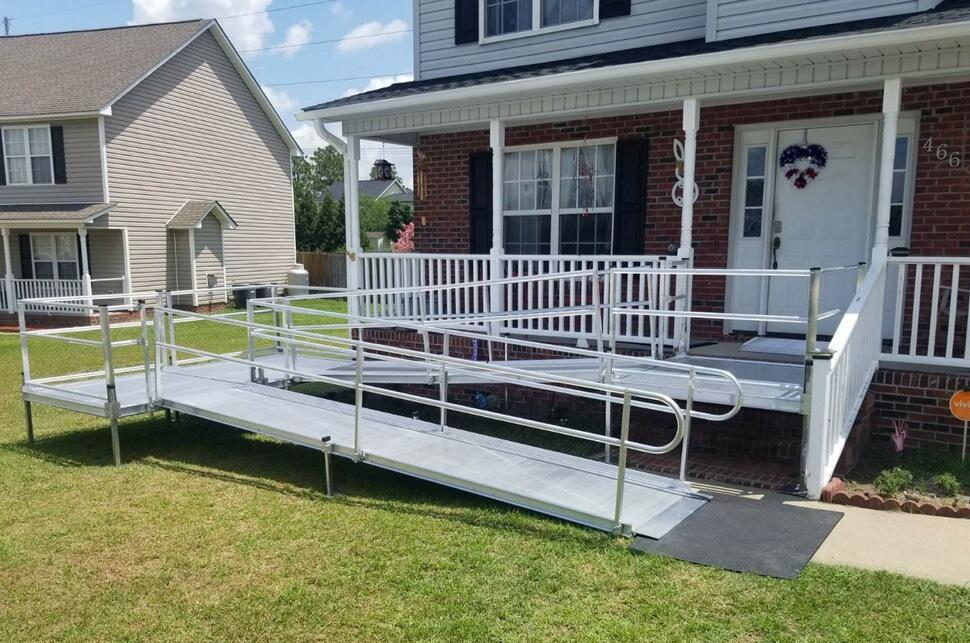
For outdoor staircases, an aluminum wheelchair ramp offers a solution that is comparable in cost to a stair lift. It also offers similar installation times and is typically the most recommended accessibility option for powerchair and wheelchair users.
For indoor rises, a threshold ramp may be an option for minimal rises or level changes, but a larger modular aluminum wheelchair ramp is not an option for larger indoor staircases due to space constraints.
Pros
- Maintenance-free (aluminum wheelchair ramps)
- Quick installation time
- Customizable to space
Cons
- Typically limited to outdoor staircases due to the amount of ramp needed, which depends on the height of rise that needs to be accommodated
- Can take up a lot of yard space
- May be exhausting for independent user to navigate independently if ramp is long
Downsize or Move into a Senior Living Facility

If none of the above solutions are a fit for your space or mobility needs, or you’re not interested in modifying your current home, another option is to move from your two-story home to a ranch (single-story home). While this may be a chore, depending on your age and the amount of stuff you need to move, it is a solution some will consider when a staircase becomes a barrier inside or outside of the house.
Moving to a single-story home could be more expensive or less expensive in monetary costs when compared to a stair lift depending on the housing market, interest rates, etc., but it will require much more time and energy than having a solution installed in your current home. Plus, the new house you move into, may not feel like “home”, if you lived in your current home for many years.
Pros
- Removes worry of having to use the stairs
- May reduce living & maintenance costs
- Potentially less maintenance/chores
Cons
- Emotional stress of moving from current home and into an unfamiliar place
- Loss of familiarity of neighbors, community, etc.
- Physical toll and hassle of moving

If downsizing isn’t a viable solution or is not preferred due to the hassles and stress that come with moving into a new house, another option is moving to a senior living or assisted living facility. However, this option will still come with the mental stress of moving and like any major change, it will be an adjustment emotionally.
Of all the stair lift alternatives considered in this article, moving into a senior or assisted living facility is also going to be the most expensive, with monthly living costs ranging between $1,500-$10,000/month or $18,000-120,000 annually. Having a mobility solution installed in your current home would pay for itself between 1-10 months vs. the cost of moving into an average senior living or assisted living facility.
Pros
- Facility will be fully accessible and safe to navigate
- Full-time support and care as needed
- More opportunities to socialize with others
Cons
- Most expensive stair lift alternative – very high monthly costs
- Loss of home independence/privacy
- Loss of familiarity of neighbors, community, etc.
Stair Lift Basics

If stair lifts may still be of interest after comparing the above alternatives, below are some of the basics:
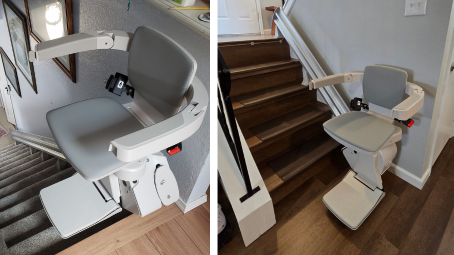
- Battery-powered – continuously charging at park stations
- Rail is installed directly onto the stairs (no damage to walls)
- Multiple safety features, such as swivel seat and safety sensors
- Foldable components to maximize space on stairs for others
- Easy-to-operate armrest controls and call/send remote control
- Variety of upgrade options to further enhance safety and convenience
Lifeway Mobility stairlifts include professional installation & demonstration, robust warranty coverage on the product and labor, and as service as needed.
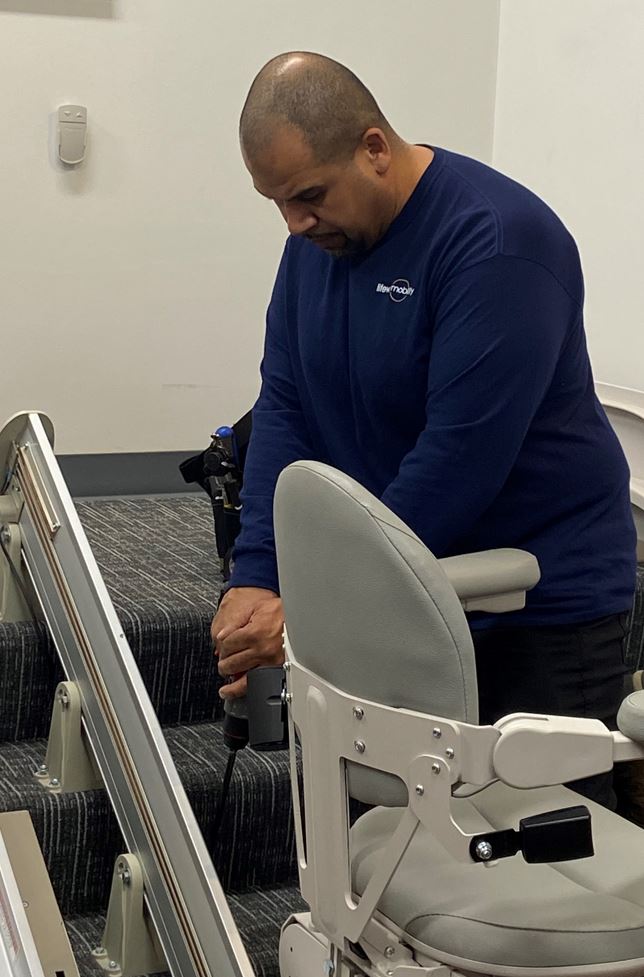
We also offer a variety of options to make stair lifts more affordable, such as:
- Financing monthly payment options through Affirm
- Funding sources – our local team may be able to connect you with a local or national resource that can help pay for your lift.
- Short-term rental options or used stairlifts
Did you know Lifeway Mobility is recognized as the “Best Stair Lift Dealer” by the National Council on Aging?
Final Stairlift Alternative Comparison
| Accessibility Solution | Best For | Wheelchair Accessible | Space Required | Travel Distance | Install Time | Typical Cost Range | Indoor/ Outdoor |
|---|---|---|---|---|---|---|---|
| Home Lifts | Two-floor access, usable space | Yes (larger cab option) | Moderate | 2 floors | 1-2 weeks | $$$$ | Indoor |
| Home Elevators | Multi-floor homes, long-term investment & value | Yes | Moderate-Large | 2-4 floors | 1-4 weeks | $$$$$ | Indoor |
| Platform Lifts | Porch or garage access | Yes | Small-Moderate | 14 ft. max | 4-8 hours | $$$ | Indoor & Outdoor |
| Wheelchair Ramps | Entryways, short rises, & quick needs | Yes | Moderate-Large | Ground-to-entry | 2-5 hours | $-$$ | Indoor & Outdoor |
| Stair Climbers | Straight staircase access, with assistance | Yes | Straight Staircase | Entire staircase | N/A | $-$$ | Indoor & Outdoor |
| Stair Lifts (baseline comparison) | Variety of staircases designs, quick need | No (transfer required) | Staircases 26" or wider | Entire staircase | 2-5 hours | $$ | Indoor & Outdoor |
Best Stair Lift Alternatives for:
- Wheelchair Users: Wheelchair Ramps or Lifts, Home Lifts & Elevators
- Multilevel Access: Home Elevators
- Preserving Usable Space: Home Lifts
- Long-Term Investment: Home Elevators
- Low Budget Option: Wheelchair Ramp or Stair Climber
Lifeway Mobility is Here to Help You Choose the Right Mobility Solution for Your Home!
We hope the above review of several stair lifts alternatives have given you a better idea of which mobility solution(s) are best for you and your family’s home and mobility needs. If a stairlift, or any of the other mobility solutions highlighted in this article, such as an elevator, platform or wheelchair ramp, are still at the top of your list, we’d be happy to set up a free consultation!

Lifeway Mobility’s local accessibility experts first take the time to understand your mobility needs and then recommend the best solutions to meet those needs. Our goal is to help you improve your safety, comfort, and quality of life at home.
Several Lifeway Mobility locations throughout the country have showrooms with stairlifts, wheelchair lifts, elevators, and/or wheelchair ramps on site. Being able to see and/or test ride these solutions can make all the difference. A visit to a showroom has proven to be very beneficial to our customers in making the best decision for their needs and home.

FAQs
What are the best alternatives to a stair lift?
Some of the best stair lift alternatives are home lifts, home elevators, platform lifts, wheelchair ramps, and stair climbers. The right option for you or a loved one will always depend on mobility needs, wheelchair use, space available, and budget. Each solution provides a different level of accessibility, and travel distance, and can vary widely in price.
Is a home elevator or home lift better than a stair lift?
A home elevator or home lift is typically going to be a better solution than a stair lift for wheelchair users, multi-floor access, and long-term planning. However, stair lifts are typically much faster to install and less expensive than home elevators and home lifts, and do not require construction. It all depends on the need!
What is the cheapest alternative to a stair lift?
A wheelchair ramp is typically going to be the most affordable stair lift alternative. However, it doesn’t mean it’s necessarily the safest or that it would even be a viable alternative, as that will depend on the person’s mobility needs, space that needs to be accommodated.
Do stair lift alternatives require major construction?
Some alternatives do and others don’t. Wheelchair ramps and platform lifts often require minimal structural changes, while home elevators may require construction, electrical work, modifications, etc. Home lifts require less construction than traditional elevators.
What are the best wheelchair-friendly alternatives to stair lifts?
Wheelchair ramps, platform lifts, home lifts, residential elevators, and stair climbers are all wheelchair-accessible alternatives to consider. Each of these alternative options allow users to remain in their wheelchair during travel, making them ideal for individuals who cannot safely transfer to a stair lift seat.
Will insurance pay for wheelchair ramps, platform lifts, and elevators?
Private health insurance and Medicare usually typically do not cover most home accessibility solutions as they do not consider them to be “of medical necessity”. However, funding may be available through Medicaid waivers, VA grants, and other local or national funding sources.
Which option adds the most home value?
Home elevators and home lifts generally add the most property value due to convenience, luxury appeal, and long-term aging-in-place benefits. Wheelchair ramps and lifts may add functional value but are often more need specific for wheelchair users.
Can these solutions be removed when no longer needed?
Yes, most wheelchair ramps, platform lifts, and stair lifts can be removed if no longer needed. Residential elevators involve more structural permanence but can still be removed.
Additional Resources
- Up and Down the Stairs Solutions
- Stair Lifts vs. Home Elevators
- Wheelchair Ramps vs Wheelchair Lifts
- Choosing a Home Elevator – Through Floor vs. Hoistway